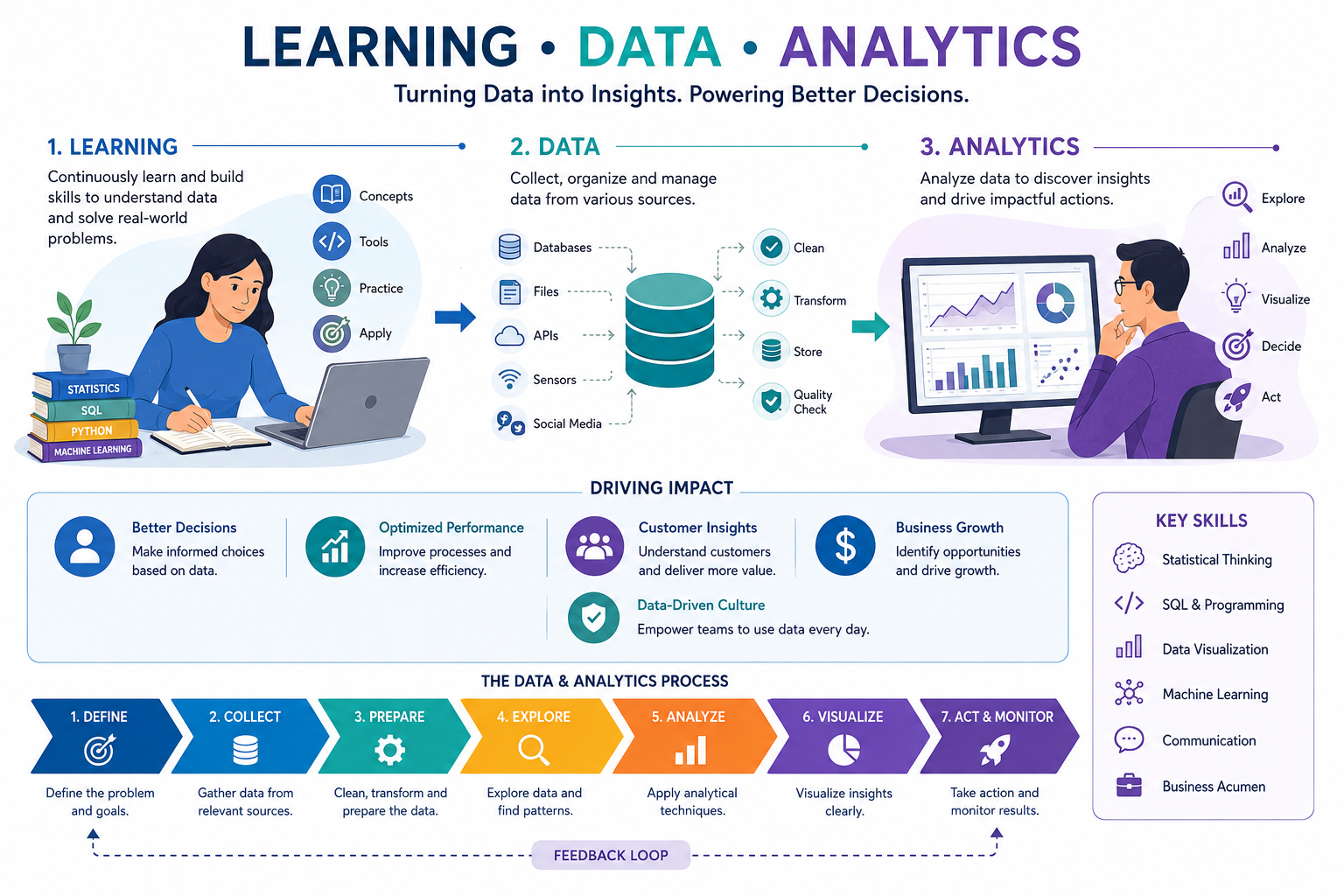
When I first heard the words “data analytics,” I honestly thought it was only for programmers, engineers, or people who were already experts in technology. At that time, I had very little confidence in my technical skills.
Learning something new as an adult can feel overwhelming. There were moments when I doubted myself, especially when I saw complicated charts, coding tutorials, and technical words that I didn’t understand.
But one thing I slowly realized is that data analytics is not only about coding. It’s really about solving problems, understanding patterns, and finding ways to improve everyday processes.
I started learning little by little. Watching beginner videos, practicing simple Excel formulas, learning basic Python, and understanding how dashboards work. Sometimes progress felt slow, but every small improvement helped build my confidence.
One of the most rewarding parts of learning data analytics is seeing how data can help solve real-world problems. Even simple charts and reports can help people make better decisions.
I also learned that making mistakes is part of the learning process. There were many times when my code didn’t work, dashboards looked messy, or I didn’t understand the results right away. But every mistake became part of the learning journey.
Over time, I started becoming more comfortable using tools like Excel, Google Sheets, dashboards, and beginner Python projects. The more I practiced, the more I realized that consistency matters more than perfection.
What helped me most was focusing on practical learning. Instead of trying to memorize everything, I tried to apply what I learned to real situations and everyday problems.
Data analytics is still a continuous learning journey for me. Technology changes quickly, and there is always something new to learn. But that’s also what makes it exciting.
If you are a beginner who feels intimidated by data analytics, remember that you don’t need to learn everything at once. Start small, stay curious, and keep practicing. Small progress over time can lead to big improvements.